

How to Stop Japanese Beetles
Need Same Day Service? We Can Help.
Call Us Now at 847-304-4144.
Japanese beetles cause two separate problems: grubs feeding on grass roots in your lawn, and adult beetles skeletonizing leaves on trees, shrubs, and garden plants. Grub damage is treated in late summer through early fall, while adult beetles are best managed with targeted, direct treatment on the plants they're actively feeding on. Treating one stage will not control the other, since adult beetles can fly in from other properties regardless of what happens in your lawn.
Why Japanese Beetles Are Two Problems, Not One
If your roses look chewed to lace by midsummer and your lawn develops loose, spongy patches by early fall, the same insect may be behind both, just in different life stages.
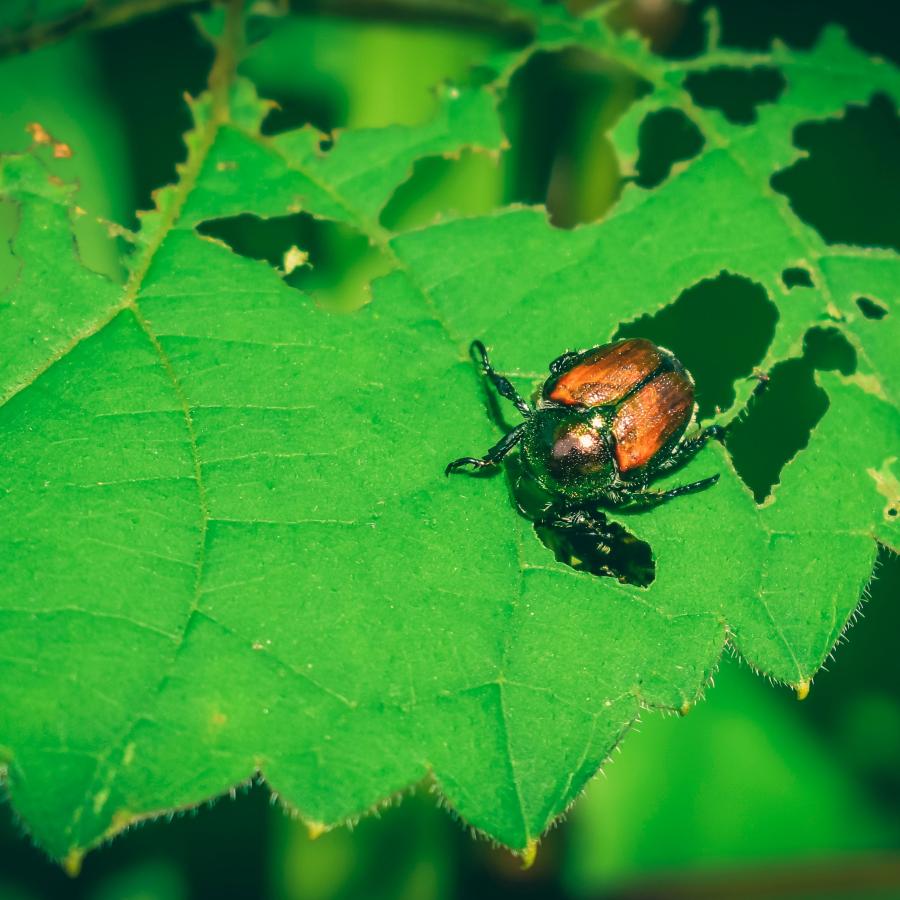
- Adult beetles emerge in early summer, typically June through August, and feed on the foliage of trees, shrubs, and garden plants. Roses, lindens, and grapevines are among their preferred hosts, and heavy feeding can skeletonize leaves down to the veins.
- Grubs, the larval stage, live underground and feed on grass roots from late summer through fall. This is what causes lawn damage: yellowing or thinning turf, followed by patches that pull up easily like loose carpet.
According to Michigan State University Extension, Japanese beetle grubs are "normally... not a problem of non-irrigated turf," though frequent summer rainfall can lead adults to lay eggs even in lawns that aren't regularly watered (Smitley). Colorado State University Extension is direct about the disconnect between the two stages: "control of Japanese beetle larvae in a yard will have very little, if any, effect on the number of Japanese beetle adults feeding on trees, shrubs and garden plants" (Cranshaw). Adult beetles are strong fliers capable of traveling considerable distances to feed, which means treating your lawn's grubs does nothing to protect your hostas from beetles that flew in from three yards over.
How to Identify and Treat Grub Damage in Your Lawn
Signs You Have a Grub Problem
- Grass yellows or browns in irregular patches, most noticeably in August
- Affected turf pulls up easily, almost like a loose carpet, because the roots have been eaten away
- Increased digging from skunks, raccoons, or birds, which target grubs as a food source
If you're unsure, cut back a square foot of turf near the affected area. Finding several white, C-shaped grubs confirms the cause.
When to Treat
- Late July through September is the ideal treatment window. Grubs are still small and near the surface at this stage, which makes them easiest to control.
- Avoid treating in spring. Overwintered grubs feed for a relatively brief time and rarely cause damage in the spring, and treating them then offers no guarantee against reinfestation later in the season.
- If your lawn has a documented history of grub damage, a preventive treatment in early summer, before eggs hatch, can help avoid a repeat problem.
Cultural Practices That Reduce Damage
A few ongoing lawn care habits make turf more resilient to grub feeding in the first place:
- Mowing at a higher height supports a deeper root system, which tolerates root damage better than a shallow-rooted lawn
- Consistent watering and fertilization help grass recover from minor root feeding
- Core aeration improves root strength and overall lawn resilience
Grub Treatment Options: Biological vs. Chemical
- Beneficial nematodes: Microscopic organisms applied as a soil drench that target grubs directly. They're specific to grubs and won't harm beneficial insects, but effectiveness is inconsistent and application requires precise timing plus immediate watering-in.
- Milky spore: A naturally occurring bacteria applied to soil that infects and kills grubs over time. It's long-lasting once established and low-impact environmentally, but slow to take hold, and university research on how consistently it works is mixed.
- Targeted insecticide: Applied directly to affected turf during the late-summer window. It delivers fast, reliable results when grubs are actively feeding, but broader-spectrum products can affect earthworms and other beneficial soil life if overused.
Turf Care's approach leans on cultural practices and targeted treatment first, reserving insecticide for lawns where an actual, confirmed grub problem justifies it.
How to Control Adult Beetles on Trees, Shrubs, and Plants
Adult beetles require a different approach entirely, since they're mobile and feeding on foliage rather than roots.
Hand-picking. For light, localized infestations, knocking beetles into a bucket of soapy water is a genuinely effective, chemical-free method. Beetles are most sluggish in early morning, which makes that the easiest time to do it. The tradeoff is that it's time-intensive on larger properties.
Pheromone traps: proceed with caution. These are widely sold as a solution, but they often attract more beetles to the area than they actually catch, which can worsen damage near the plants you're trying to protect. If used at all, they need to be placed well away from valuable plants, never near them. Generally not recommended for home landscapes.
Targeted treatment over blanket spraying. Turf Care's approach to insect control has always been to treat what actually needs treating, not to apply insecticide automatically as part of a standard program. Beneficial insects, including the earthworms that help aerate soil, can take years to recover from unnecessary insecticide use. For moderate to heavy feeding on specific plants, targeted treatment is more effective, and safer for the rest of your landscape, than a broad application. The tradeoff is that it requires professional identification of what actually needs treating.
Should You Treat Both Stages?
Not automatically, and not for the same reason. If your lawn has a history of grub damage, treating that stage in late summer is worthwhile on its own merits, since it protects your turf directly. But that treatment won't reduce the beetles landing on your roses or hostas; that requires a separate, targeted plan for your plants. The two problems share a species, not a treatment.
When to Call a Professional
Bring in a lawn and landscape professional if:
- You're seeing grub damage but aren't sure of the extent or whether treatment is actually needed
- Adult beetle feeding is heavy enough to threaten a tree or shrub's overall health, not just its appearance
- You want a plan that treats only what needs treating, rather than a blanket program
Turf Care Enterprises' green team assesses your lawn and landscape in person before recommending treatment, so you're not guessing at what's actually going on or paying for treatment you don't need.
Next Steps
Get a free estimate, and our team will evaluate your lawn and landscape before recommending a plan.